
Wake Forest and Rankings

Do rankings matter?
What defines Wake Forest?
Students are attracted to Wake Forest’s promise to prepare them to do well in life so that they can do good in the world.
Our approach to developing students to lead with character and integrity rests in our liberal arts roots and faculty engagement. Students love being taught and mentored by faculty at the top of their fields who conduct research and produce scholarships with a positive impact on society. Opportunities abound for mentored research, study abroad experiences, experiential learning and interdisciplinary studies. And students love rallying around their classmates as they compete for national championships in the ACC.
This unique combination of a personalized academic experience with big-time college sports sets Wake Forest apart from large public universities and private colleges.
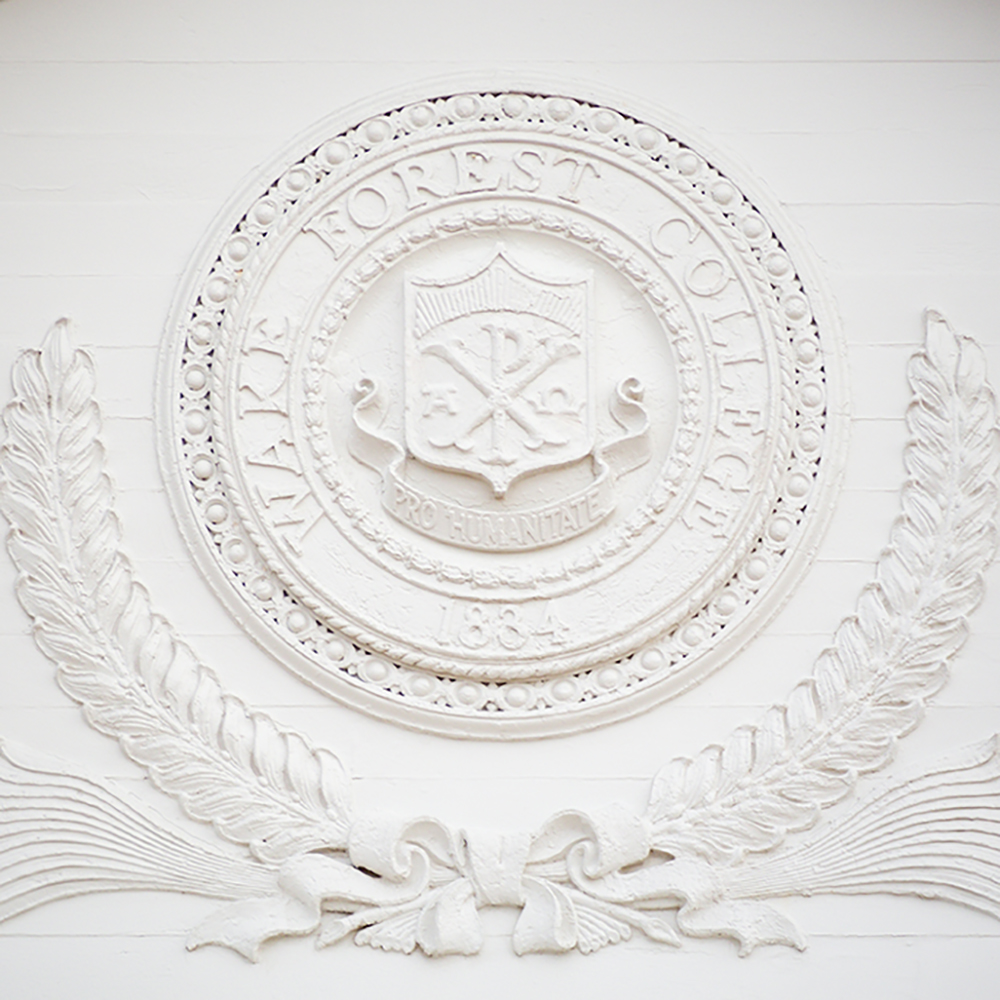
Here are a few of the measures that matter the most to us:
86 %
of class sections have fewer than 30 students, and 99% of class sections have fewer than 50 students.
94 %
of full-time faculty have a doctorate or other terminal degree.
97 %
of graduates in recent years were employed or enrolled in graduate programs within six months of graduation.
85 %
of the Class of 2025 graduates declared a second major and/or minor.
86 %
of students have a for-credit study abroad experience.
96 %
is the graduation success rate for Wake Forest athletes, sixth among Power Four schools.
If you love numbers, then what about rankings?
Traditional Rankings
The rankings landscape has been dominated by U.S. News & World Report, and yes, Wake Forest touted its top 30 ranking for more than three decades. We recognize that the U.S. News rankings are consequential for how Wake Forest is perceived by the marketplace. However, no ranking adequately characterizes Wake Forest’s academic excellence, personalized student experience, and comprehensive educational ecosystem of graduate and professional programs. For the past few years, in its assessment of national universities, the ranking criteria have diverged from what Wake Forest believes are key factors in educating the whole person.
Methodology Changes
In 2023-2024, U.S. News & World Report changed 17 of the 19 indicators used to calculate its institutional rankings. This included removing foundational elements of Wake Forest’s approach, such as class size and faculty with terminal degrees. In subsequent years, it has continued to change its methodology.

Questioning the methodology
A report from NORC (National Opinion Research Center) at the University of Chicago, a research organization, examined five major rankings, including those from U.S. News and The Wall Street Journal. Among its findings:
- It’s impossible to know exactly what’s being measured because methodologies aren’t clear.
- Data quality isn’t consistent, making it hard to trust assessments of even clearly defined metrics.
- Subjective factors are treated as critical, making it hard to compare different colleges.
Wake Forest is not defined by rankings
At Wake Forest, the purpose of education is to better oneself for the sake of bettering humanity (see ourmottomeansmore.com). This drives a commitment to the liberal arts, to recruiting faculty who engage students in their research and bring their scholarly expertise into the classroom. In recent years, U.S. News & World Report rankings have not included some of the indicators that align with our priorities of challenging classes, personal attention and mentoring from professors who are top scholars and experts in their fields.
Wake Forest’s approach to education is in high demand
Our undergraduate applications have increased in each of the past six years. For the Class of 2030, Wake Forest received a record number of applications (more than 21,000). Selectivity has also increased during this time: Our acceptance rate has gone from 32% in recent years to 19% for the Class of 2030.
Wake Forest students are in high demand
Our students consistently secure positions at top organizations and gain acceptance into prestigious graduate schools. Within six months of graduation, 97% of students in the last five graduating classes were employed or enrolled in graduate programs.
“I think that what happens is that employers themselves and graduate schools don’t really look at rankings because they use their own criteria to measure the quality of the candidates, not based on what some media outlet is telling you is good or not,” said Andy Chan, the vice president of innovation and career development at Wake Forest.
Chan points to a Gallup-Strada survey that showed that about 9 out of 10 employers do not consider college rankings when making hiring decisions.
Recognition of Wake Forest’s academic strength continues to grow
Our commitment to academic excellence produces exceptional outcomes. A few recent highlights:
- Wake Forest is recognized as the national model for leadership and character education. It has received more than $80 million from major foundations to help other colleges and universities build their own character programs. Through its Educating Character Initiative, the Program for Leadership and Character has built a community of educators from 800+ higher education institutions who are developing and implementing ideas to integrate character education into their culture and curricula. More than 100 faculty and staff also participated in a Leadership and Character Certificate Program in 2025-26.
- In the past four years, six Wake Forest faculty have won highly competitive CAREER awards, the National Science Foundation’s most prestigious award for young faculty intended to provide a foundation for a lifetime of scientific leadership that integrates research and education. The awards total more than $3.4 million.
- Through collaborative research, innovative curriculum development and new faculty hires, a focus on Neuroscience and Society aims to expand and enhance Wake Forest’s vibrant community dedicated to advancing neuroscience for the benefit of individuals and society.
Wake Forest University’s priorities have never been driven by external rankings. Instead, they are rooted in the institution’s mission and values. Wake Forest remains steadfast in its stated commitments, goals and vision for the University and continues to strive for offering the best possible educational opportunities. The University is committed to providing real data and success metrics to demonstrate the value of a Wake Forest education and its impact on the lives and careers of its students.

Transformational Experience
Wake Forest believes the purpose of education is to better oneself for the sake of bettering humanity. This drives a commitment to the liberal arts, to recruiting faculty excited to involve undergraduates in their research and bringing that research into the classroom, and to a University-wide approach to developing leaders of character and integrity. Ask our students, alumni, faculty and staff what Pro Humanitate means to them, and their answer will define Wake Forest.